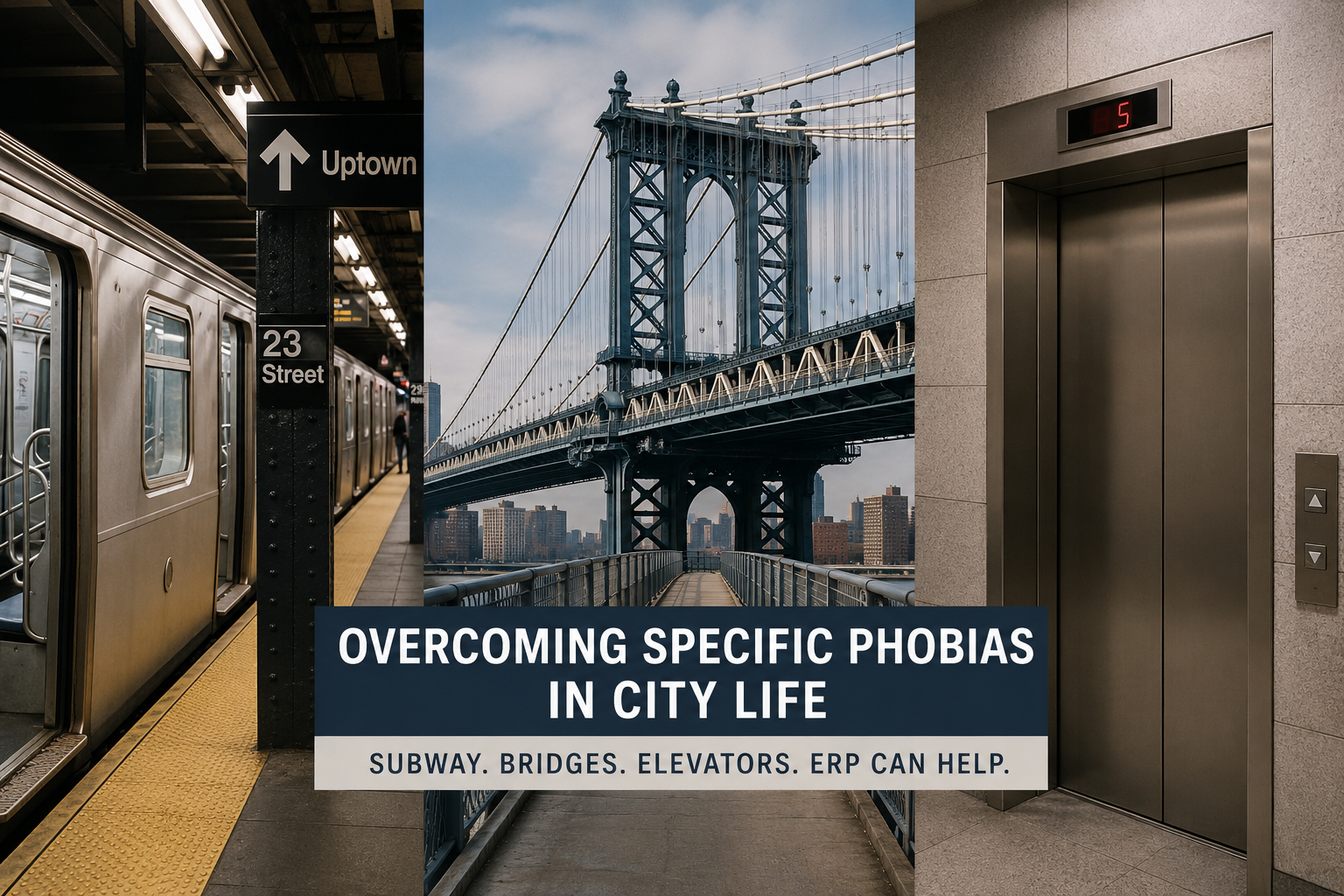
Specific Phobias in City Life: ERP Tips for Urban Anxiety
Living in a city like New York City means navigating subways, bridges, elevators, tunnels, and crowded buildings almost every day. For many people, these are routine parts of urban life. But for others, they trigger intense fear, panic, and avoidance.
At Downtown Psychological Services, we regularly work with clients struggling with specific phobias related to city life — fears that can quietly shrink your world and limit your independence.
The good news? These fears are highly treatable. One of the most effective approaches is Exposure and Response Prevention (ERP).
What Are Specific Phobias?
A specific phobia is an intense, persistent fear of a particular object or situation. In city environments, common phobias include:
Fear of the subway (claustrophobia, fear of being trapped, fear of panic)
Fear of bridges (often fear of losing control while driving)
Fear of elevators (fear of getting stuck or suffocating)
Fear of tunnels or enclosed spaces
Fear of crowded public transportation
These fears often involve catastrophic thoughts like:
“What if I panic and can’t escape?”
“What if I faint?”
“What if I lose control?”
“What if the elevator gets stuck and no one helps me?”
Over time, avoidance becomes the primary coping strategy — taking Ubers instead of the train, driving miles out of the way to avoid bridges, waiting endlessly for stairs instead of using elevators.
While avoidance reduces anxiety in the short term, it strengthens the phobia in the long term.
Why City Phobias Feel So Intense
Urban phobias often feel more overwhelming because:
The feared situation is unavoidable in daily life.
Escape feels limited (e.g., underground trains, bridge traffic).
The environment is stimulating and crowded.
There’s pressure to “function normally” despite anxiety.
In cities like New York, it can feel embarrassing to struggle with something “everyone else” seems to handle easily. But phobias are not a character flaw — they are a nervous system learning pattern.
And learning patterns can be changed.
What Is Exposure and Response Prevention (ERP)?
Exposure and Response Prevention (ERP) is a gold-standard treatment for phobias and anxiety disorders.
Exposure means gradually and intentionally facing the feared situation. Response Prevention means resisting the usual safety behaviors or avoidance strategies that keep the fear cycle going.
The goal is not to eliminate anxiety instantly. The goal is to retrain your brain to learn:
“This is uncomfortable — but it’s not dangerous. I can handle it.”
Here’s what ERP might look like in practice for Subways, Bridges, and Elevator Fears:
Build a Fear Ladder
You and your therapist create a hierarchy of feared situations, from least to most anxiety-provoking.
For example, with a subway phobia:

    Looking at photos of a subway platform

    Standing outside a station entrance

    Walking down the stairs without boarding

    Riding one stop during off-peak hours

    Riding multiple stops during rush hour

    Gradual exposure builds confidence step by step.
Drop Safety Behaviors
Safety behaviors feel protective but actually reinforce fear.
Examples:

    Only standing near subway doors

    Constantly checking for exits

    Avoiding eye contact

    Taking “rescue” medication preemptively

    Calling someone to stay on the phone during exposure
In ERP, we gently reduce these behaviors so your brain can fully learn that the situation is safe — even without crutches.
Stay Long Enough for Anxiety to Shift
Many people flee exposures when anxiety spikes. ERP teaches you to remain in the situation long enough for your nervous system to naturally settle.
Anxiety rises.
Anxiety peaks.
Anxiety falls.
This process builds tolerance and confidence.
Repeat, Repeat, Repeat
Repetition rewires fear. The more you practice, the less power the phobia has.
With consistent ERP work, clients often report:
Less anticipatory dread
Shorter panic spikes
Increased independence
A larger, freer daily life
Common Misconceptions About ERP
“Exposure sounds overwhelming.”
Good ERP is gradual and collaborative. You are never thrown into the deep end.
“What if I actually panic?”
Panic is uncomfortable — not dangerous. Part of treatment is learning that you can survive and recover from it.
“I should just push through on my own.”
While some people make progress independently, structured ERP with a trained therapist tends to be more effective and sustainable.
When to Seek Support
If your fear is:
Limiting where you go
Impacting your job or commute
Causing significant distress
Leading to complicated workarounds
Expanding to new situations
It may be time to seek professional support.
Specific phobias are among the most treatable anxiety disorders. With the right approach, meaningful change often happens faster than people expect.
City life should expand your world — not shrink it.
At Downtown Psychological Services, we specialize in evidence-based treatments for anxiety, and pull from Exposure and Response Prevention for specific phobias. Our therapists work collaboratively and compassionately to help you move toward the life you want — whether that means riding the subway confidently, driving across bridges without dread, or stepping into elevators without hesitation.
You don’t have to reorganize your life around fear.
You can reclaim your commute, your independence, and your city.
Looking for therapy for phobias in NYC? Fill out this form to schedule your free 10-15 minute phone consultation to learn more about treatment at Downtown Psychological Services.