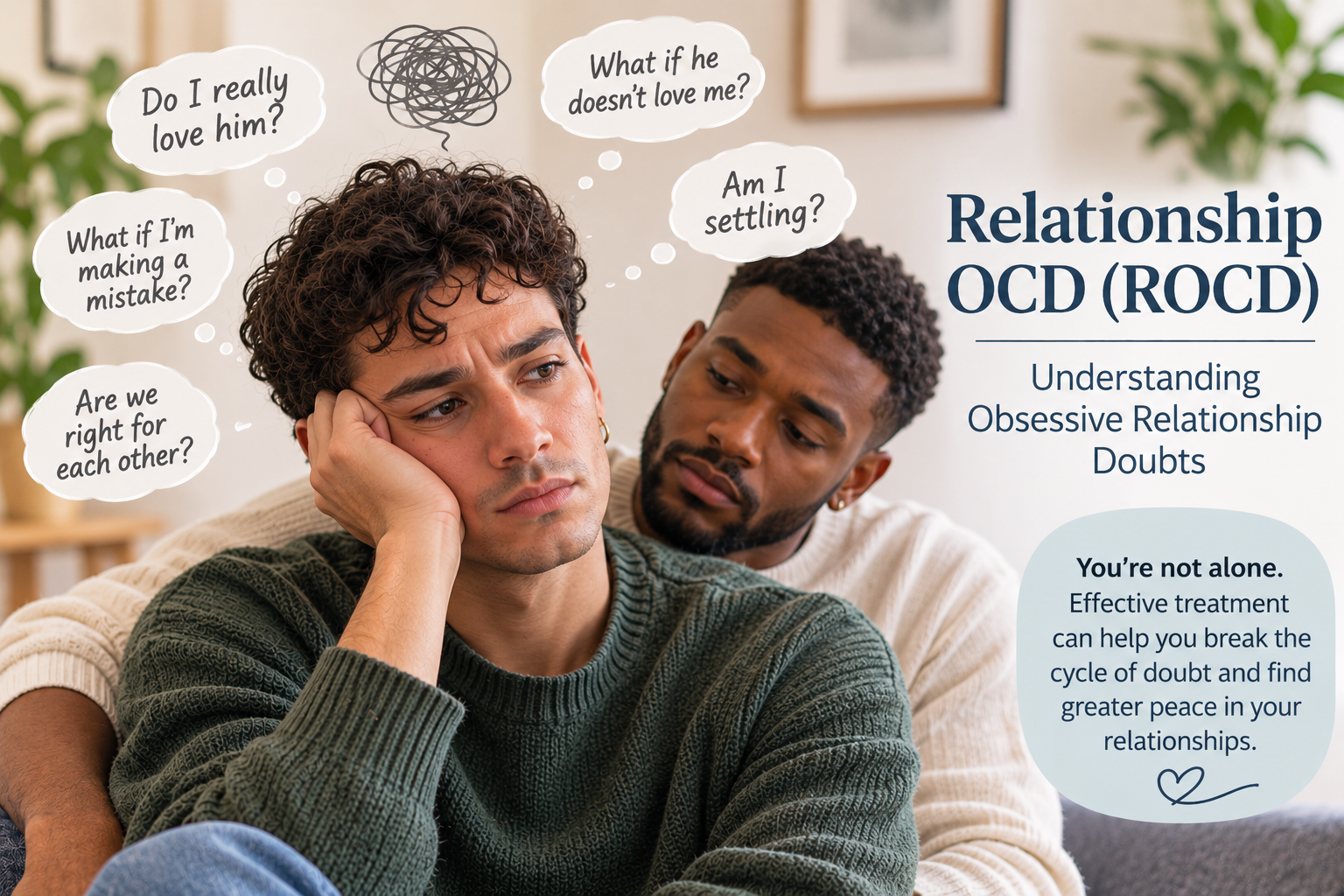

Relationship OCD (ROCD): Symptoms, Signs, and Treatment Options
/What Is Relationship OCD? Understanding Obsessive Relationship Doubts
Relationships naturally come with moments of uncertainty, but for individuals with Relationship Obsessive-Compulsive Disorder (ROCD), doubt can become overwhelming. Questions like “Do I really love my partner?”, “Are we right for each other?”, or “What if I'm making the wrong decision?” can turn into persistent, distressing thoughts that interfere with daily life and relationship satisfaction.
At Downtown Psychological Services, we understand how challenging relationship OCD can be and how important it is to recognize the difference between normal relationship concerns and obsessive-compulsive patterns.
What Is Relationship OCD (ROCD)?
Relationship OCD is a subtype or presentation of Obsessive-Compulsive Disorder (OCD) in which individuals experience intrusive, repetitive doubts and fears related to their romantic relationships.
These obsessions may focus on:
Whether you truly love your partner or your partner truly loves you.
Whether your partner is attractive, intelligent, or compatible enough.
Whether the relationship is “right” or destined to last.
Whether you are settling or making a mistake.
Whether certain feelings, interactions, or moments mean something is wrong.
Unlike typical relationship concerns, ROCD-related doubts are often persistent, difficult to dismiss, and accompanied by significant anxiety. Even when there is no clear relationship problem, the individual may feel an overwhelming need to find certainty.
The Cycle of Doubt and Reassurance
One of the defining features of relationship OCD is the cycle of obsessive doubt and compulsive reassurance-seeking.
When an intrusive thought appears, an individual may attempt to reduce anxiety by:
Repeatedly asking their partner whether they are loved.
Comparing their relationship to other couples.
Analyzing their feelings to determine whether they are “in love.”
Seeking advice or reassurance from friends, family, or online sources.
Mentally reviewing conversations, memories, or interactions for signs that something is wrong.
Although these behaviors may provide temporary relief, reassurance rarely resolves the underlying anxiety. Instead, it can reinforce the OCD cycle, making the doubts return with greater intensity.
Over time, this pattern can create emotional exhaustion, strain communication, and negatively affect intimacy and relationship satisfaction.
How Does Relationship OCD Affect Relationships?
ROCD can affect both partners, even when the relationship itself is healthy and supportive. The individual experiencing OCD may feel guilty, confused, or frustrated by their inability to stop questioning the relationship.
Their partner may also feel overwhelmed by repeated questions, reassurance-seeking, or seemingly constant relationship evaluations.
It is important to remember that experiencing relationship OCD does not necessarily mean a relationship is unhealthy or that the individuals involved are incompatible. The distress often comes from the obsessive-compulsive cycle rather than an actual relationship issue.
Treatment for Relationship OCD
The good news is that relationship OCD is treatable. Evidence-based OCD treatment can help individuals change their relationship with intrusive thoughts, reduce compulsive behaviors, and develop greater tolerance for uncertainty.
Exposure and Response Prevention (ERP) is considered the gold-standard psychotherapy for OCD. ERP involves gradually confronting situations, thoughts, or uncertainties that trigger anxiety while resisting compulsive responses, such as reassurance-seeking or mental checking.
Other helpful treatment approaches may include:
Cognitive Behavioral Therapy (CBT): Helps individuals recognize unhelpful thinking patterns and change their responses to obsessive doubts.
Exposure and Response Prevention (ERP): Helps reduce compulsions and build tolerance for uncertainty without seeking immediate relief.
Mindfulness-based strategies: Encourage individuals to notice intrusive thoughts without automatically engaging with or trying to resolve them.
Medication management: For some individuals, medication such as selective serotonin reuptake inhibitors (SSRIs) may be recommended in collaboration with a qualified prescribing professional.
Treatment focuses not on proving whether a relationship is right or wrong, but on helping individuals stop treating every doubt as a problem that needs an immediate answer.
Finding Support for Relationship OCD Living with relationship OCD can feel isolating, especially when intrusive thoughts create ongoing uncertainty about someone you care about. However, you do not have to navigate these challenges alone.
At Downtown Psychological Services, we recognize the impact OCD can have on relationships, emotional well-being, and everyday life. Working with a qualified mental health professional who understands OCD can help you break the cycle of obsessive doubt and reassurance-seeking.
With appropriate treatment and support, it is possible to build a healthier relationship with uncertainty, reduce anxiety, and experience relationships with greater confidence and emotional freedom.
If relationship OCD is affecting your life or relationship, contact Downtown Psychological Services to learn more about treatment options and how therapy can help.